
Post 2: The Perfect Storm: AI Isn't Creating Your Pressures — It's Accelerating Them
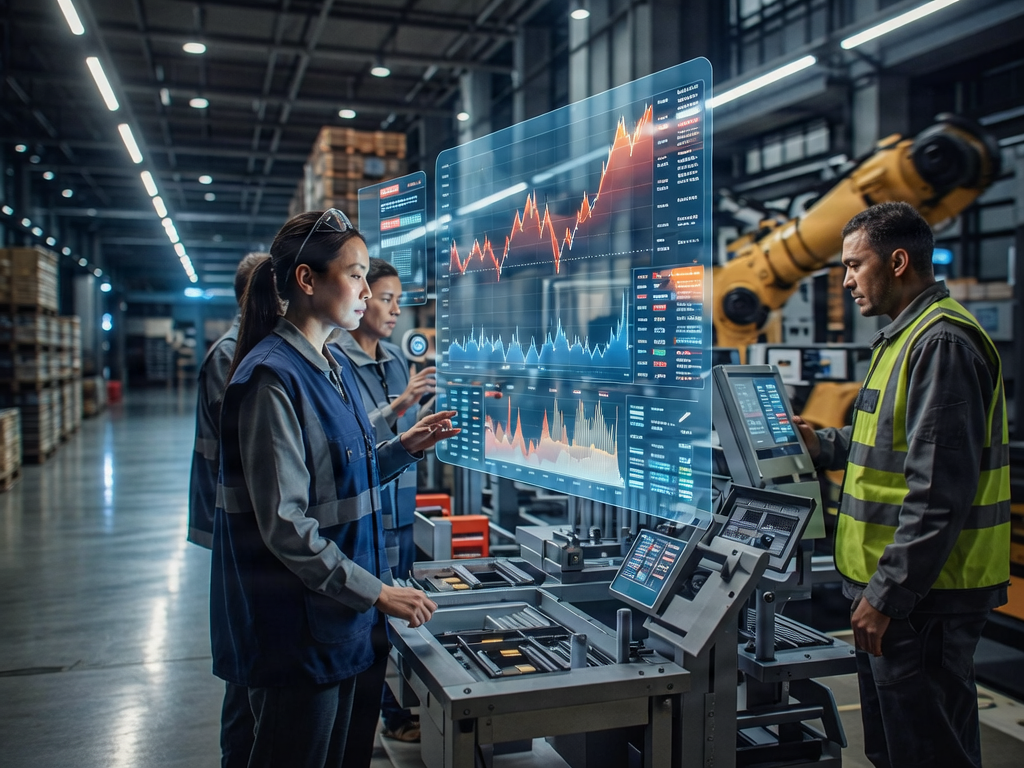
Costs, talent, supply volatility and demanding customers were here long before AI. What has changed is how fast falling behind now compounds.
Ask a manufacturing CEO in Singapore, Penang or Batam what keeps them awake, and AI is rarely the first answer. The first answers are older and more familiar: input costs that ratchet up and never quite come down, skilled people who are harder to hire and are retiring with decades of know-how in their heads, supply chains that swing between shortage and glut, and customers who now want not just a good part, but proof.
That list is the storm. AI did not create it. But AI is changing how quickly it punishes slow adaptation, and that changes the strategic question every leader must answer
From the book: Chapter 1 · The Perfect Storm, in The 99% Factory: From Output to Outcome.
Four pressures, one shift
The pressures on manufacturing SMEs arrive separately, but together they create a single shift in the basis of competition.
Cost. Energy, labour, materials and compliance all cost more than they did five years ago. Margin that was once protected by a keen quote now erodes quietly.
Talent. The experienced setter, technician or planner is getting harder to replace. When they leave, quality dips and lead times stretch, and months are spent rediscovering what was already known.
Volatility. Tariff shifts, logistics shocks and customers relocating supply all mean that the plan made in January rarely survives to June.
Evidence. Many leaders underestimate this. A decade ago, a stamping or moulding SME competed largely on price per part and reliable delivery. Today the same customer’s purchasing scorecard weighs traceability, defect data, responsiveness to change, and the supplier’s ability to show that its process is in control. Two firms can ship an identical part. The one that can attach the evidence and answer a quality query in an hour rather than a week keeps the contract and commands the margin.
Put together, these pressures re-rate what a factory is for. It is no longer only a place that converts material into product. It is a system that converts information into good decisions, fast enough to matter to a customer.
Why AI is an amplifier, not the cause
It is tempting to read AI as the disruptor. It is more accurate to read it as an amplifier of a divide that already existed.
AI rewards firms that already have connected data, clear decisions, and disciplined processes, because they can point AI at a real problem and gain leverage. It offers far less to a firm whose data is trapped in disconnected machines and spreadsheets, because it has nothing coherent to act on.
So the arrival of accessible AI does not level the playing field. It widens the gap between firms that built foundations and those that didn’t. In a slower era, a firm could lag on data and decisions for years without paying an obvious penalty. That grace period is closing. The pressure did not begin with AI, but AI is shortening the time between “we’ll modernise eventually” and “we’ve lost the account”.
This leads to a conclusion that surprises many boards: for most SMEs, the highest-return “AI” investment is not AI at all. Connected data and decision discipline make AI worth adding later.
The trap: treating the storm as a procurement problem
When pressure converges, the most common response is to buy something. An MES. A dashboard suite. An “AI platform”. The vendor demo is impressive, the case study comes from a famous plant, and the board feels it has acted.
Six months later, the system impresses on a factory tour and changes nothing on the floor. Nobody ever specified which decision it was meant to improve, what evidence that decision needed, or what outcome it should move. Technology bought ahead of a defined decision becomes cost and complexity, not capability.
The alternative is less exciting and far more effective: name the decision first, and let it pull the technology.
Three lenses on the same storm
In the book, every chapter examines the problem through three lenses, because transformation fails when you ignore any one of them.
- For the CEO, the storm is a shift in how customers judge you. Your job is to decide which pressure is existential in the next twelve months, and fund only the capability that answers it.
- For the engineer, the storm becomes a series of architecture choices that must stay safe, interoperable, maintainable and affordable. The danger is over-engineering a showcase. The discipline is building the smallest foundation that improves the next decision.
- For the operator, none of it matters unless it reaches the point of work: clearer information at the machine, faster escalation when something drifts, fewer avoidable reworks. If the answer doesn’t make the shift easier to run, it has failed, no matter how advanced it is.
From pressure to decision
The practical move is to trace each pressure down to the recurring decision underneath it. A useful sequence:
- Name the pressure in one sentence. “Our Tier-1 customer now requires lot-level traceability.”
- Name the customer outcome at stake, in the customer’s own words. “Zero traceability findings at audit.”
- Name the recurring decision that most affects that outcome. “When to stop the line and change a tool,” or “whether this batch is fit to release.”
- Name the owner of that decision today. Often it is one person, and often they are close to retirement.
- Name the evidence that would make the decision observable: a few signals, a record of what was decided and why.
- Describe “better” in 90 days: fewer escapes, faster release, a measured drop in scrap.
That is exactly what the Outcome Canvas, the first tool in the book’s Executive Playbook, asks you to fill in. It fits on one page and shifts the boardroom conversation from “which system should we buy?” to “which decision should we fix?”
A note for policymakers and partners
The storm is not only a firm-level problem. When tacit process knowledge leaves the workforce, the economy loses. When support schemes reward visible “AI adoption” more readily than the unglamorous connectivity and data discipline that make adoption viable, the foundation stays underfunded. And when reporting imposes cyber and standards requirements at a multinational scale, they can crush the very firms they are meant to strengthen. Proportionality, and support sized for a first decision rather than a first plant, would raise the floor for far more firms.
This week’s question
Which pressure, if you do nothing, is most likely to cost you an account in the next twelve months? And which recurring decision sits underneath it?
If you can answer those two questions, you have already done more strategic work than most AI roadmaps I see.
Your next step: Outcome Canvas